
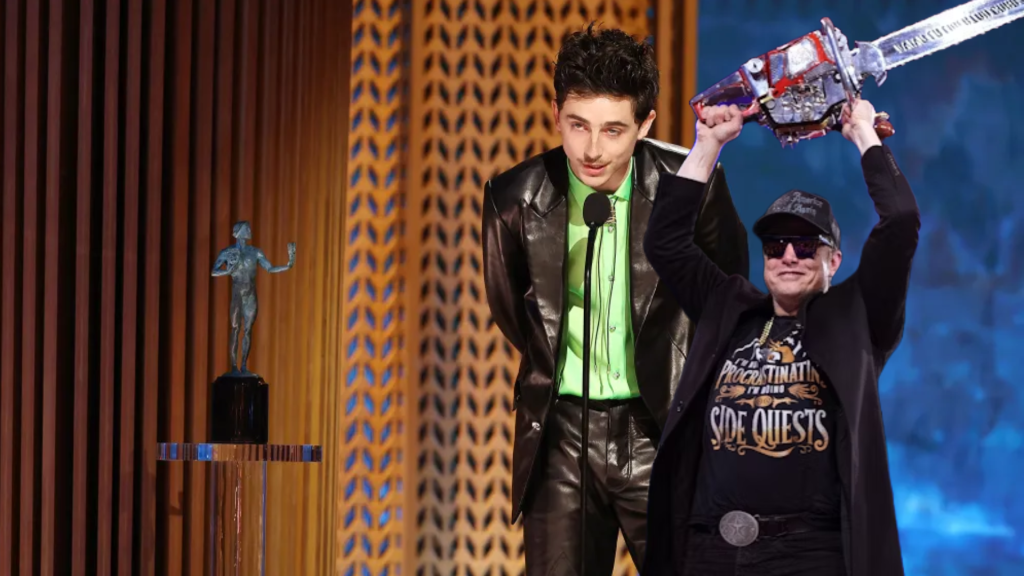
Over the past few days, we saw two representations of greatness on big stages:
The first was Elon Musk at the Conservative Political Action Conference (CPAC), where he paraded around with a Chainsaw over his head, signifying how hard he was working making cuts to federal bureaucracy. This came shortly after Musk bragged about having his DOGE staff working 120-hour weeks.
The second representation of greatness was Timothee Chalamet, who was understated during his acceptance speech for Outstanding Performance by a Male Actor at the Screen Actors Guild (SAG) awards. Chalamet thanked some core people in his life, spoke for a few moments about the effort and dedication that went into the role, and ended by saying that while the trophy is nice, what he cares about most is continuous improvement, studying the greats, and wanting to pursue excellence and greatness himself.
Elon Musk has taken the same approach to the federal government that he did at Twitter: chaos and rash actions, such as firing a bunch of air-traffic controllers and then trying to rehire them. Chalamet’s rendition of Bob Dylan in A Complete Unknown is incredible whether you are left, right, or down the center. You don’t even have to like Bob Dylan or music to watch the film and forget it’s an actor, not the real thing.
Musk and Chalamet’s portrayals of greatness couldn’t be more different. One represents pseudo-greatness. The other represents the real thing.
We aren’t here to get political. Anyone who is being honest can say that Musk has (or at least had) remarkable execution chops. You can get lucky once with a start-up, but it’s hard to get lucky multiple times. We can also say that it’d be great if the federal government would work more efficiently! Maybe Musk will pleasantly surprise us and be the one to do it, but we have our doubts. One of the main reasons for those doubts is that Musk appears to be falling for the trap of pseudo-greatness. (And also because it seems spending hours upon hours scrolling and posting on Twitter/X has turned Musk’s brain into sawdust, which ought to serve as a cautionary tale for all of us.)
Pseudo greatness is more concerned with performing the act of greatness than actually striving for it. It’s no different than the fitness influencer who documents their entire life beginning with a hype speech from a cold-plunge at 5 AM, whereas real athletes are too busy training to have time for the performative kabuki.
It’s the running influencer who is spending their time talking a big game and posting videos designed to make you think they are fast, or maybe even coming up with some ridiculous challenge that no one else does to make them seem great. Meanwhile, the greatest runners of all time, athletes like Eliud Kipchoge and Faith Kipyegon, are off training on some dirt road in the middle of nowhere. The former might look impressive, and there’s no denying that it takes effort to perform greatness for the internet. But it’s a world apart from the pursuit of actual greatness.
Coach Tom House, perhaps the best throwing coach for ball sports on the planet, told us about the commonalities between greats he’s worked with, including Nolan Ryan, Drew Brees, and Tom Brady: “They were all addicted to the process. Winning is a byproduct. They get addicted to the process because it’s what they can control. Wins only take them out of the process for moments.”
Pseudo greatness puts appearance first, making you look like you are a badass. True greatness is about putting in the work to give yourself a shot at actually becoming a badass. It’s fluff and entertainment versus depth and substance.
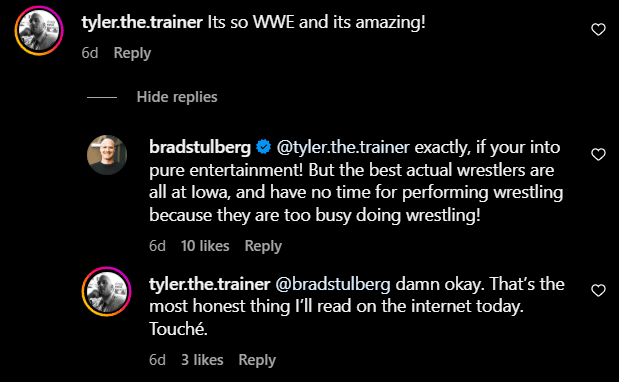
Shortly after the Musk chainsaw incident, Brad made a post on Instagram pointing out the difference between someone who runs around on stage being super loud and bragging about how great they are versus someone who has no time or energy for that because they are consumed with actually getting better. An exchange in the comments gets to the heart of the matter.
Once you are aware of the distinction between pseudo greatness and true greatness, you can’t help but see it everywhere. The former is loud, arrogant, in your face, frantic, frenetic, cycles from fad to fad, and chases attention. The latter is unglamorous, quiet, confident, consistent, respects the craft, and in love with the process of self-discovery.
When you are looking for role-models and inspiration, or thinking about what greatness means to you and how you can pursue your own version of it, keep this distinction in mind. In a world of shallow and performative everything, push yourself to go deep and be about the real thing.
– Brad and Steve


